Key takeaways
- AI chatbot use among medical, nursing, and emergency medicine students is already universal: a 2026 study found 100% prevalence, with reduced thinking cited by 40% of students as their top concern about their own habits (Tan et al., 2026).
- A randomized controlled trial found that misleading AI explanations nearly cut medical students' diagnostic accuracy in half, while correct AI explanations produced no measurable improvement over unassisted performance (Teng et al., 2026).
- "Never-skilling" describes the risk of learners failing to develop clinical reasoning abilities as a result of early over-reliance on AI tools; it’s distinct from deskilling (losing a skill already acquired) and mis-skilling (accepting an AI's incorrect output as fact).
- DDx by Sketchy is a clinical reasoning training tool, providing a structured practice environment in which to develop and evaluate clinical reasoning skills, rather than an AI chatbot that hands over conclusions.
Every student in your program is already using AI to work through cases.
A 2026 study of 300 undergraduate health professions students found a100% prevalence of AI chatbot use. Studying was the leading reason students cited for their use of AI (Tan et al., 2026).
When researchers asked those students what worried them most about their own AI habits, their top answer wasn't getting caught or paying subscription costs.
It was reduced thinking (40% of respondents).
AI that hands over answers doesn't just fail to help, it actively hurts
Never-skilling describes what happens when AI hands over an answer before a learner has done the work to earn it (Berzin & Topol, 2025).
There’s a related risk worth knowing about: mis-skilling, when a learner uncritically absorbs an AI's wrong or biased output and internalizes it as fact.
A randomized trial published this year in npj Digital Medicine gives clear evidence of why this matters (Teng et al., 2026). Medical students were presented with mini cases and received AI-generated diagnostic explanations: some correct and some wrong. Researchers then measured the effect of the AI explanations on the accuracy of the students’ final diagnoses.
While correct AI explanations didn't improve accuracy, incorrect ones did significant damage: accuracy dropped to less than half of the no-explanation baseline.
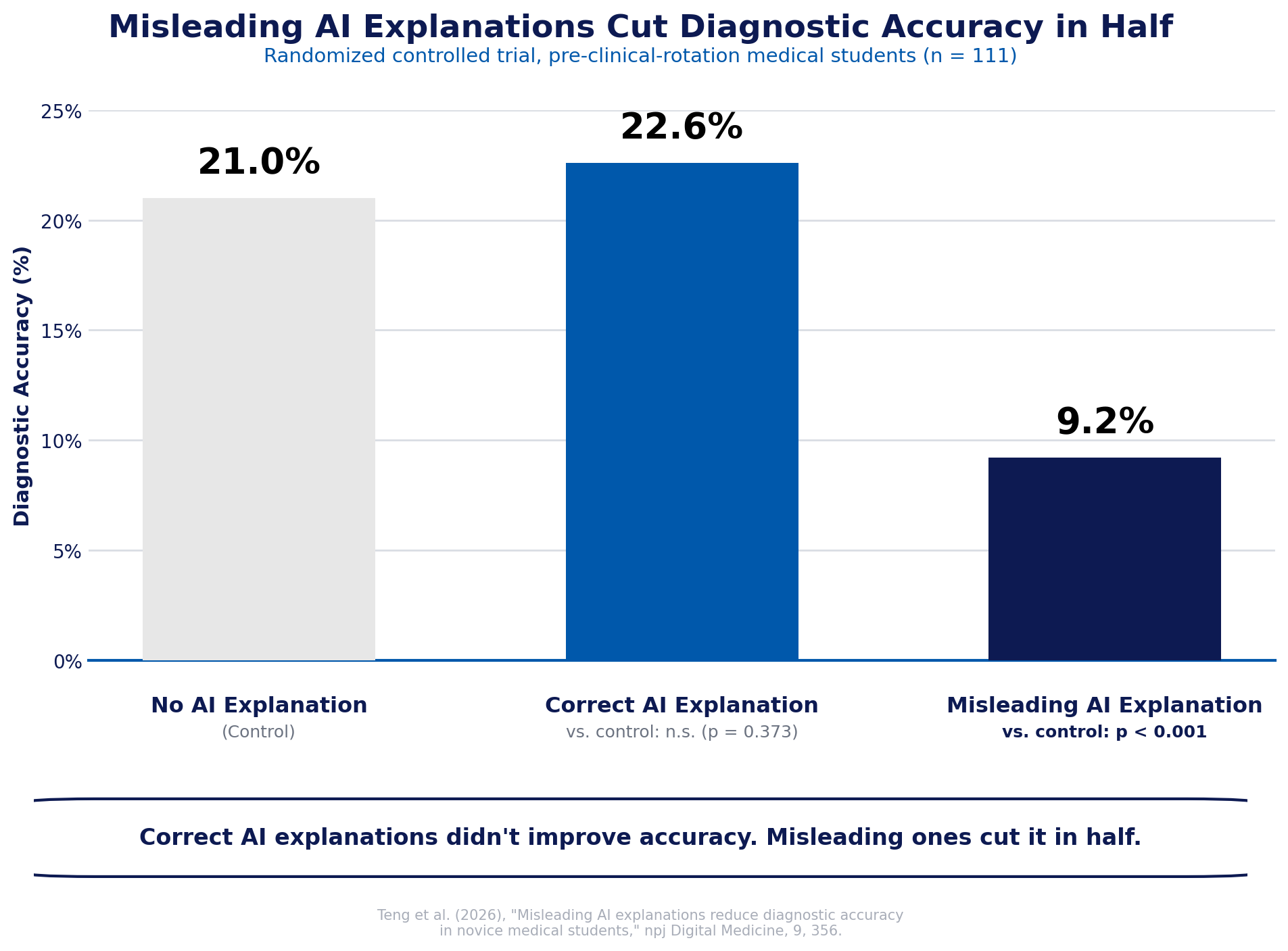
Despite the disparity in diagnostic accuracy, student confidence was not significantly different between the correct and misleading groups. Students feel just as confident when AI hands them a wrong answer, and may never realize their error, further underscoring the importance of developing reasoning abilities before relying on these tools.
Catching an incorrect AI output takes a clinical reasoning foundation that comes from the same repeated practice AI dependence skips. Without that foundation, a student can't tell safe AI use from reckless delegation of clinical reasoning to a machine.
This pattern isn't unique to medicine, either. Researchers studying AI use across broader populations have given the underlying mechanism a name: cognitive offloading, the well-documented tendency to let a tool think so we don't have to (Gerlich, 2025).
At Sketchy, we think that's reason enough to be deliberate, now, about how AI shows up in clinical education.
AI isn't the enemy. Design is what matters.
We think that the difference between AI that helps and AI that harms comes down to a simple design choice: whether the model runs every step of a task or keeps a human in charge.
Clinicians in practice today had already built a foundation before AI tools emerged. Now, AI chatbots are available from the first day of medical school, before students have begun to grasp the fundamentals.
We don't think AI is bad for clinical reasoning. We think many AI education tools are built the wrong way.
It's fair to ask whether this is the same concern people had about calculators, imaging, and electronic health records. None of those tools ended up eroding core clinical skills the way critics feared.
Ke et al. (2026) take the comparison seriously in a recent Nature Medicine commentary, but feel strongly that AI tools are different. Earlier tools changed the kind of cognitive work a clinician did, but they didn't remove it. A CT scan still demands expert knowledge to interpret. Lab values still require clinical integration. But today's AI models can execute the entire diagnostic and management pathway, substituting for a human's cognitive work.
Why we built DDx this way
We didn't want to create an AI tool that hands over answers. Instead, we built DDx by Sketchy to be an AI-enabled clinical reasoning training that only gives correct answers after learners commit to their own reasoning. Preparing healthcare students to use AI safely is part of our product design philosophy.
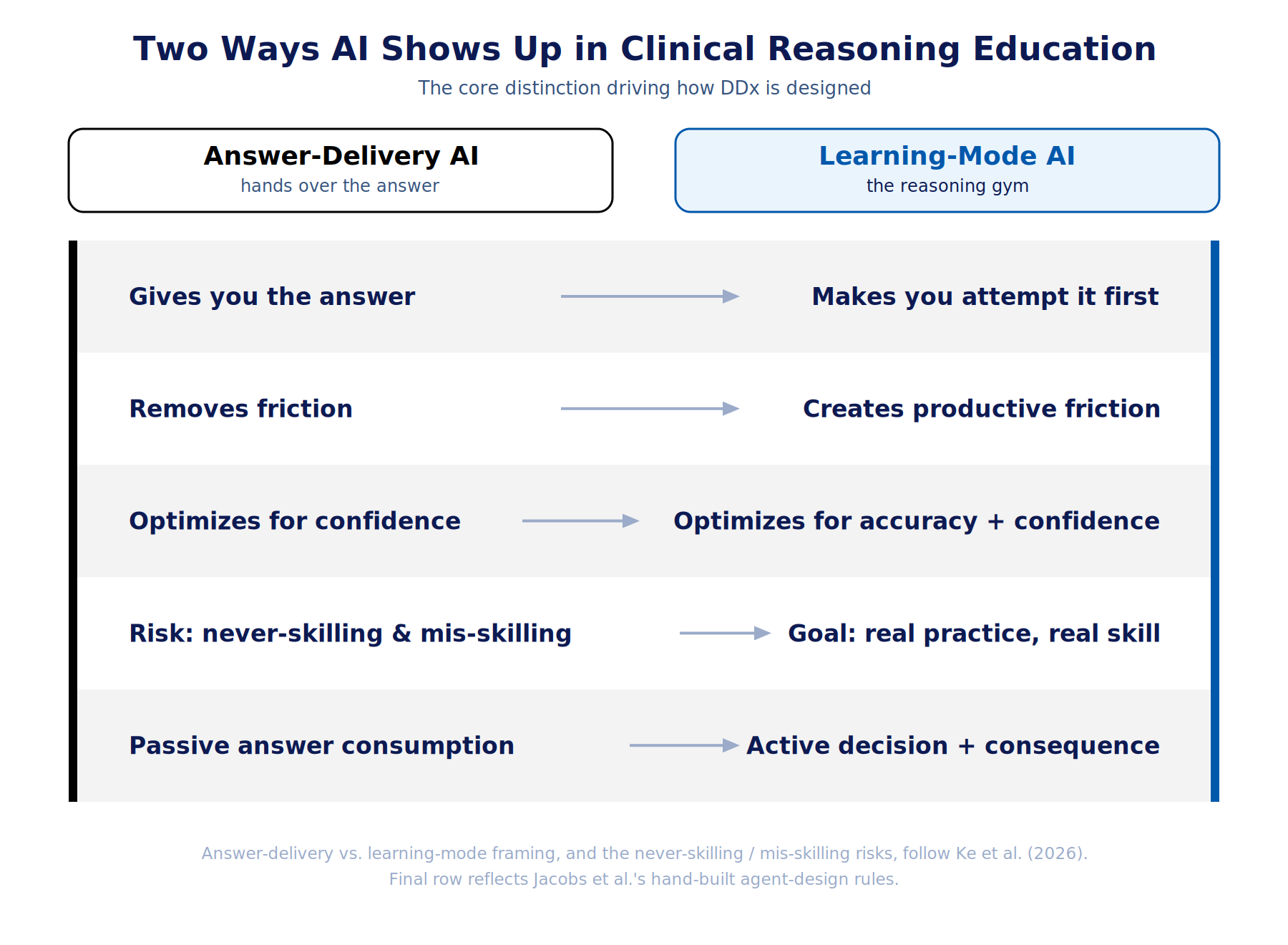
The Nature Medicine authors also recommended a curriculum design principle for AI-generated tools. Assess learners on their ability to catch, explain, and correct errors embedded in AI-generated reasoning. Only then should they move on to collaborate with the tool.
That recommendation matches how we'd already built DDx. Our team designed DDx as a structured practice environment. A student's performance gets logged and scored, and faculty responsible for certifying outcomes can see it and decide whether, and how, to intervene.
In practice, that means a student learning in DDx has to work through a case step by step and set out their own reasoning before the tool reveals whether they were right. Immediately after each simulation, DDx provides students with a performance summary and targeted feedback so they know how to improve.
We chose to optimize our AI-enabled platform to help students learn the process of clinical reasoning, not just to get an answer. That’s how we built a learning platform that prevents never-skilling.
Students have noticed the difference, and their reactions to DDx show they’re hungry for this kind of learning.
- “It really challenged me to come up with the differentials, and I often was stumped, so when I finally did get it, I was excited.”
- “It really made me think about what questions I wanted to ask, what info I wanted to know, and how I could problem-solve to get my answers.”
- “I felt challenged enough to learn, but supported enough to not feel like giving up.”
AI never-skilling isn’t inevitable: it’s a design choice. The question worth asking is which choice your AI tools are making for your students.
Frequently Asked Questions
What is never-skilling in medical education?
Never-skilling describes the risk that AI tools introduce clinical reasoning skills too early. With never-skilling, students appear competent while using AI but never build the underlying judgment to reason independently, or to identify errors made by the AI tool. Unlike deskilling, which is losing a skill already learned, never-skilling means the skill never fully develops in the first place.
What's the difference between never-skilling and mis-skilling?
Never-skilling means a clinical reasoning skill never develops in the first place because AI did the cognitive work before the learner could. Mis-skilling means a flawed skill develops instead because the learner absorbed an AI's incorrect or biased output as fact without catching the error. DDx by Sketchy is designed to guard against both: it withholds answers until a student reasons independently, and it uses expert-developed scenarios to avoid mistakes introduced by AI.
Does AI improve or hurt diagnostic accuracy in medical students?
It depends on how the AI is designed. A 2026 randomized controlled trial found that AI explanations that handed students an incorrect diagnosis cut diagnostic accuracy in half, while correct AI explanations produced no measurable improvement over having no AI assistance at all (Teng et al., 2026).
What is DDx by Sketchy’s clinical reasoning training philosophy?
Our product design philosophy where AI creates productive friction rather than removing it, requiring learners to commit to a reasoning attempt before revealing an answer, rather than delivering conclusions immediately. DDx by Sketchy is built around this model.
How does DDx by Sketchy help prevent AI over-reliance?
DDx withholds diagnostic answers until students commit and analyze their attempts so faculty can track their learning process, not just final answers.
Sources
- Berzin, T. M., & Topol, E. J. (2025). Preserving clinical skills in the age of AI assistance. The Lancet, 406(10513), 1719.
- Gerlich, M. (2025). AI tools in society: Impacts on cognitive offloading and the future of critical thinking. Societies,15(1), 6.
- Ke, Y., Jin, L., Ong, J. C. L., Thirunavukarasu, A., Car, J., Cheung, C. Y., Tham, Y. C., Ting, D. S. W., Ong, M. E. H., Compton, S., Narayan, A., Keane, P., Wong, T. Y., Bates, D., Tan, P., & Liu, N. (2026). AI-induced never-skilling in medical education. Nature Medicine, 32(6), 1997–2006.
- Li, J., Ai, F., Wang, J., Cheng, B., Li, Y., & Chen, Z. (2026). Application of AI-generated content in medical education: Systematic review of the impact on critical thinking abilities of medical students. JMIR Medical Education, 12, e79939.
- Tan, J. W. D., Oh, H. X., Krishnan, V., et al. (2026). Prevalence of AI chatbot usage and factors associated with AI dependency among medical faculty undergraduate students. Frontiers in Education, 11, 1750324.
- Teng, D., Tan, L., Cao, Q., et al. (2026). Impact of AI misinformation on diagnostic accuracy and confidence calibration in novice medical students. npj Digital Medicine, 9, 356.