Educators who use DDx immediately see its value in action — we’re confident you will too.
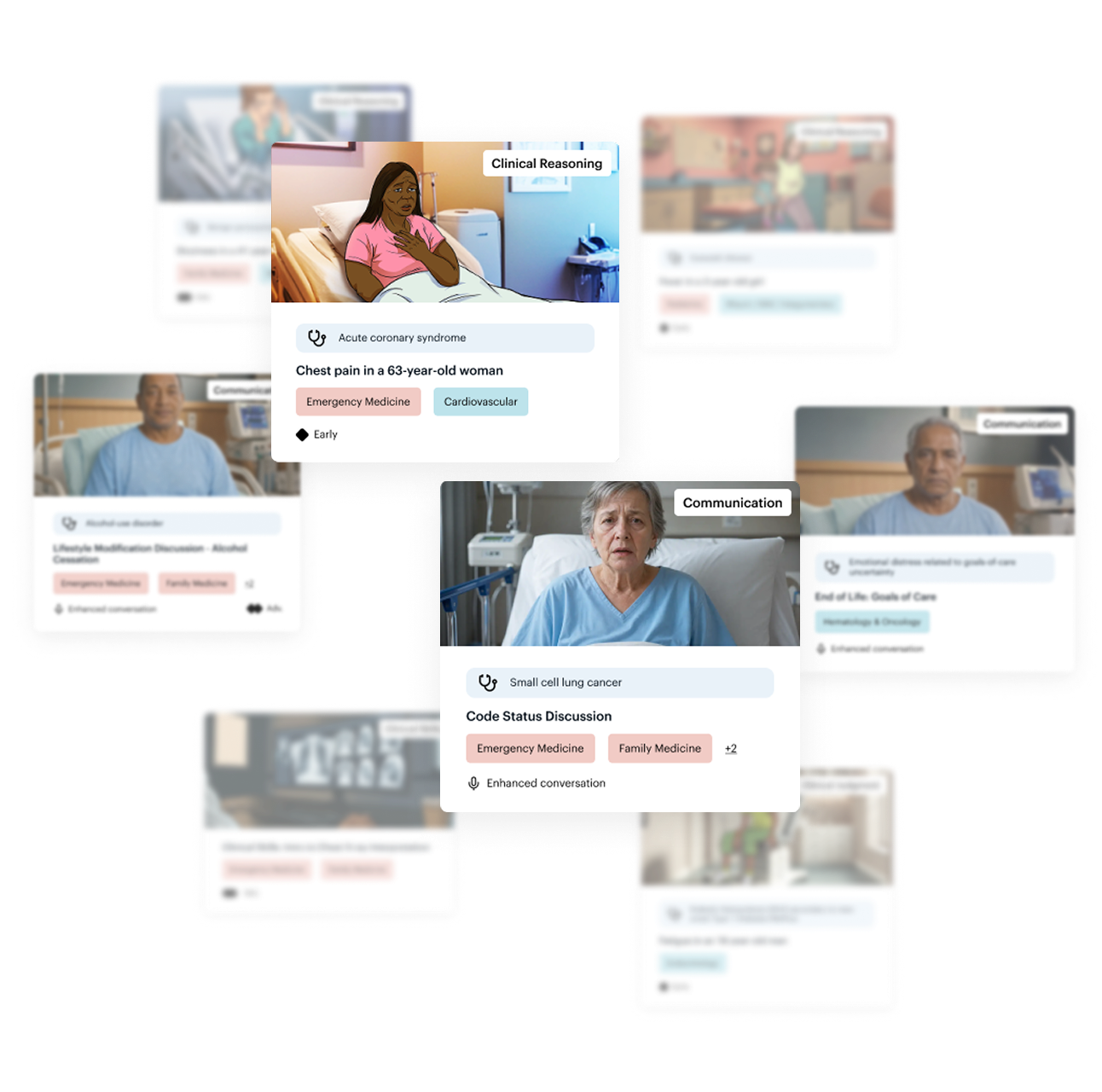
Explore how our interactive, AI-powered cases bring clinical reasoning to life at scale
Assess students consistently through rubric-based evaluations aligned with competencies
Enable personalized feedback and get insights to inform targeted remediation plans
AI is reshaping how clinicians think and make decisions — accentuating the need for strong clinical reasoning skills. Faculty need the right tools to teach and assess reasoning skills effectively at scale — ensuring students stay critical, thoughtful, and ready for practice.
The most comprehensive end-to-end clinical encounter training, built on a faculty-developed case library
Safe, highly engaging, multi-role simulations for learners to practice clinical reasoning and interpersonal skills
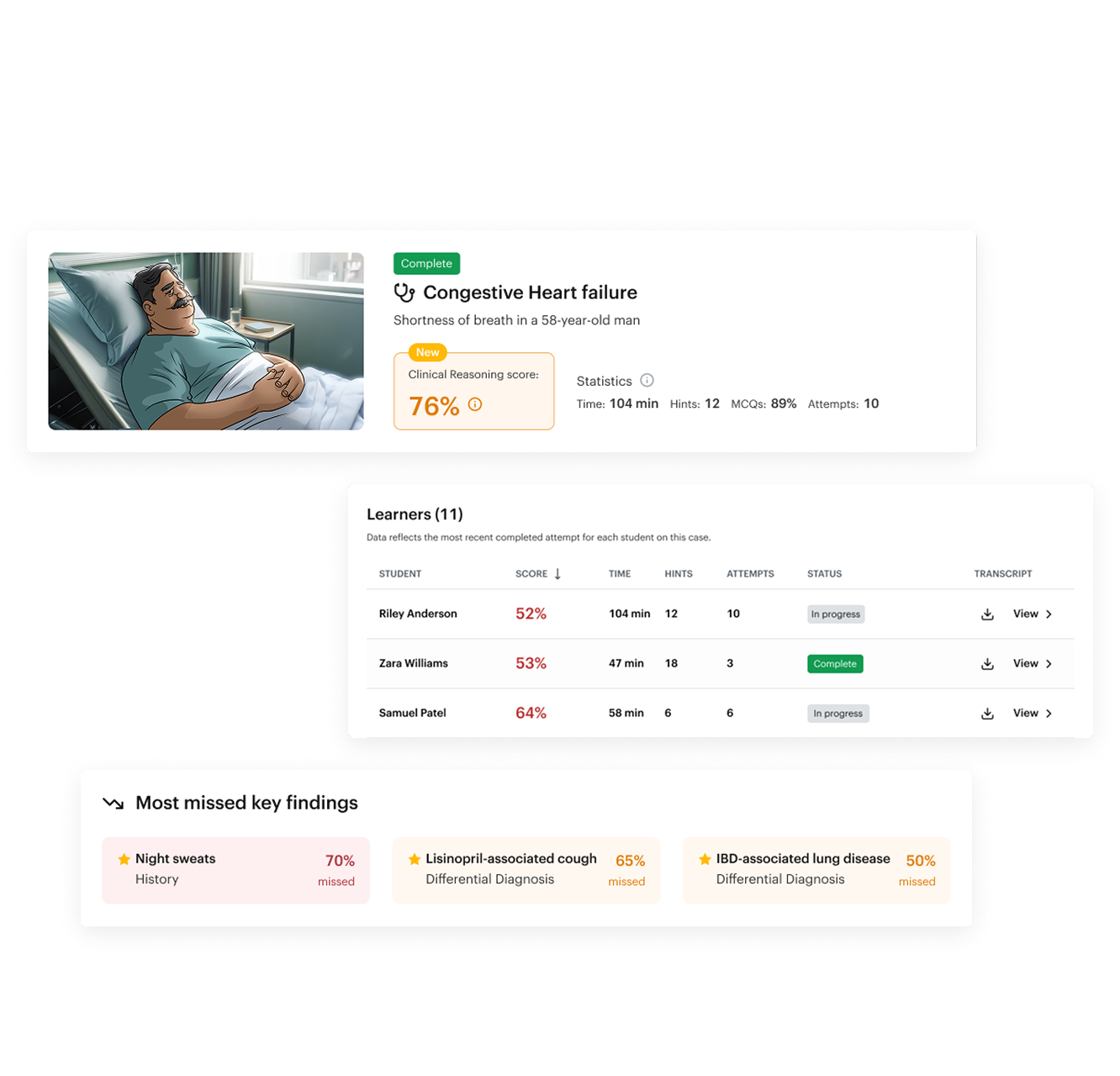
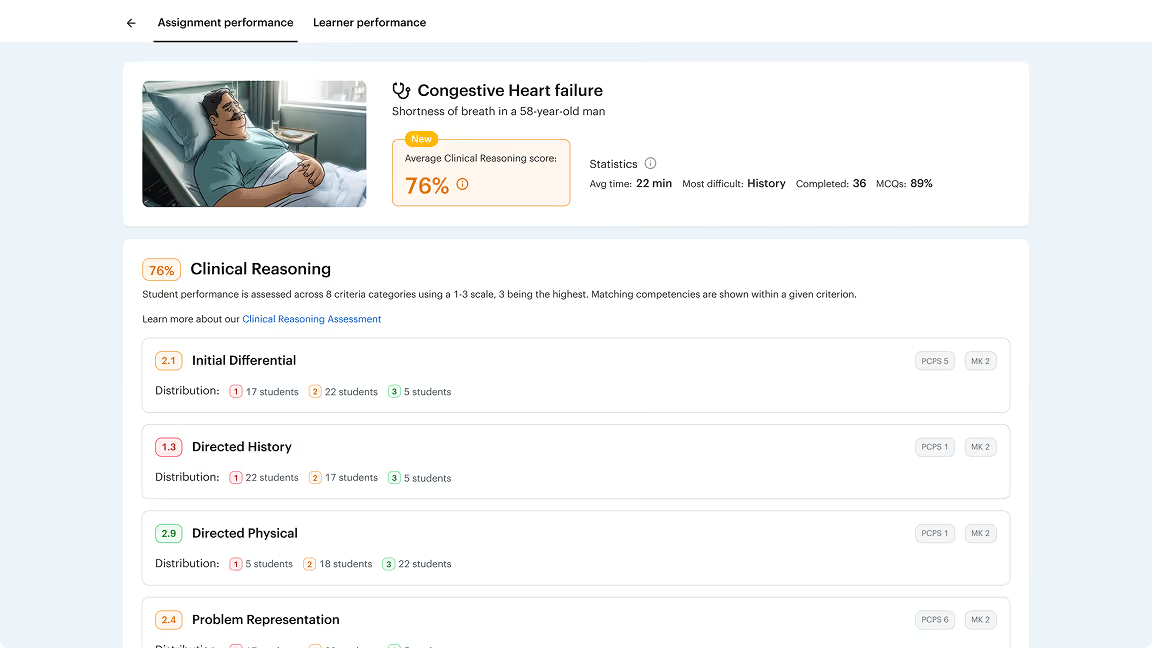
Transparent insight into student decision-making, enabling faculty to strengthen learners’ ability to think critically and clinically
Reliable exposure to dynamic, real-world scenarios that expand and evolve with the clinical landscape
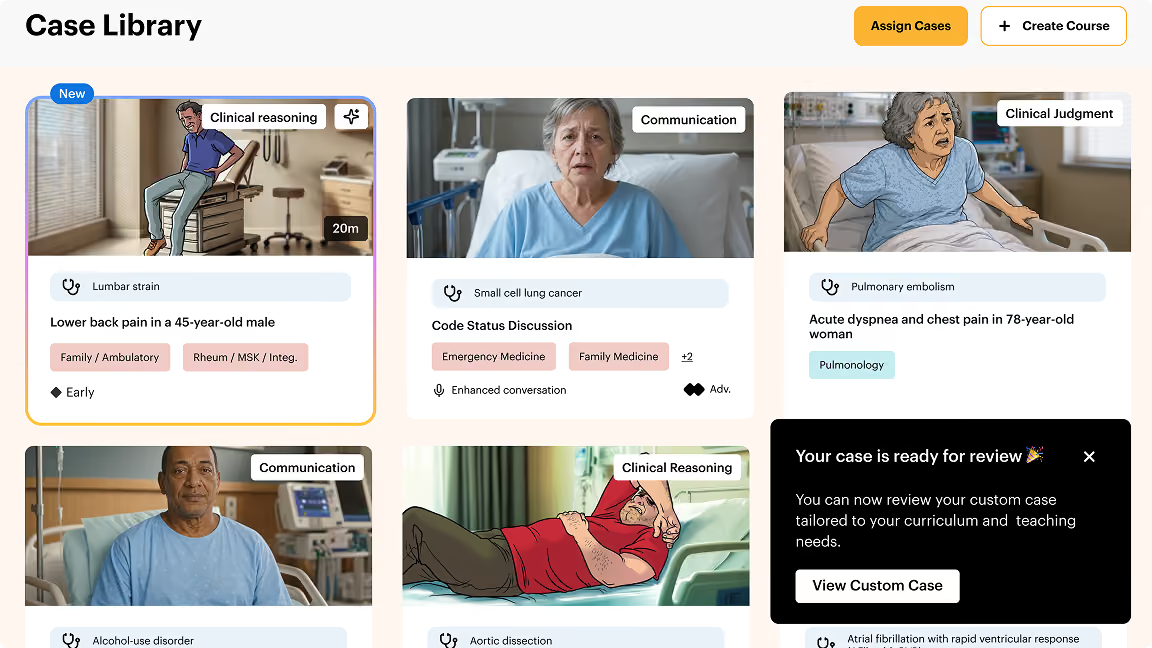
200+ cases that can be incorporated into curricula
Rubric-based assessments for consistent, competency-aligned evaluation
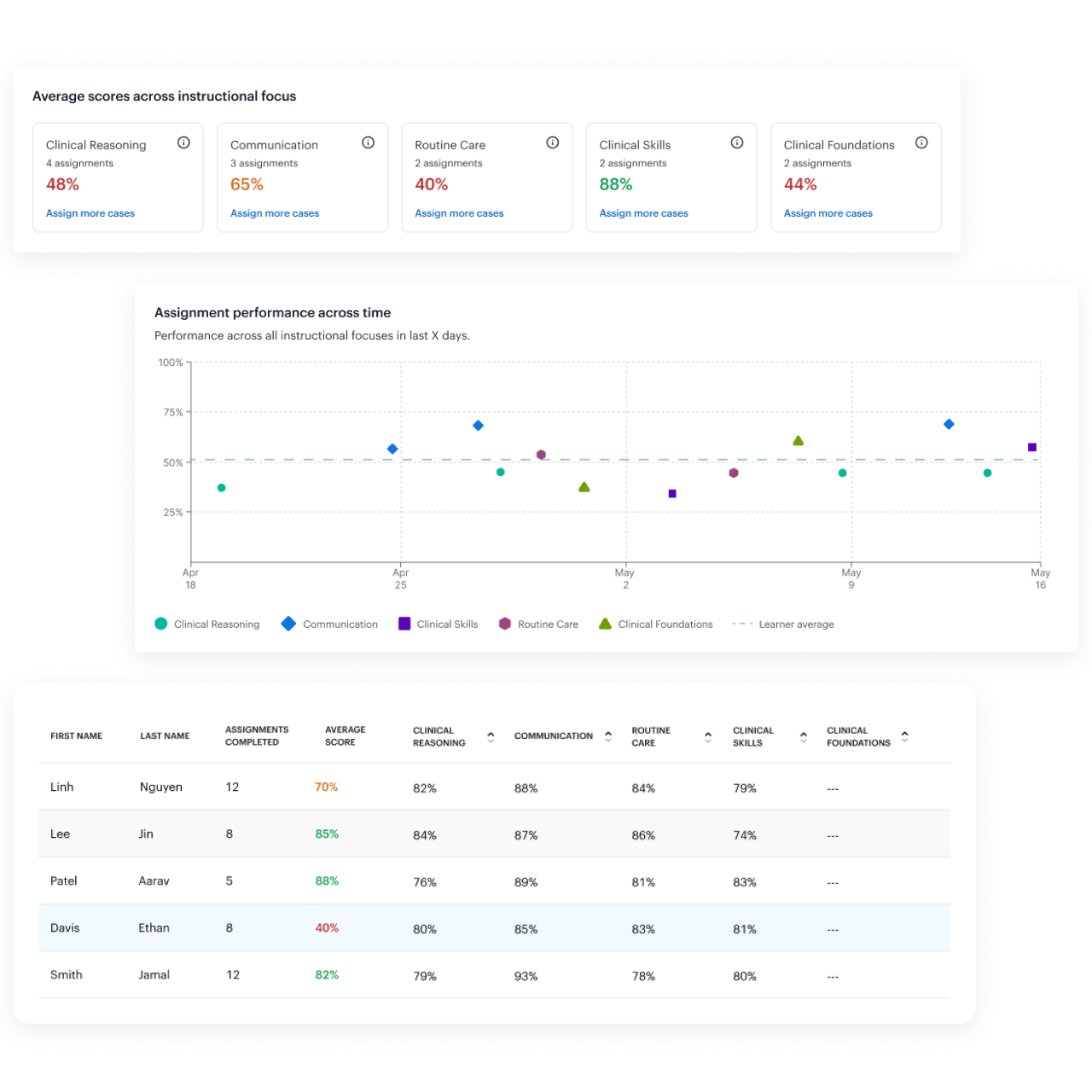
Centralized dashboards that provide clear views of cohort and individual progress and trends
Streamlined delivery that significantly reduces administrative burden and frees faculty time
Adaptive simulations that grow in complexity as students advance
Tools for faculty to provide personalized, targeted feedback at scale, and insights to inform remediation plans
AI that elevates clinical education — blending deep clinical expertise with advanced reasoning, analytics, and interactivity


Associate Professor, University of Puerto Rico School of Medicine
Programs use DDx to broaden case exposure, scale access to simulation, deepen assessment, and deliver targeted remediation.
With a flexible, customizable platform that boosts training capacity without adding to faculty workload, DDx transforms how programs can equip learners and make them clinically ready.
Give learners access to high-quality clinical encounters earlier and more consistently, both in commonly seen cases and rare presentations.
Enhance or extend traditional OSCE and simulation programs with industry-leading virtual encounters focused on clinical reasoning.
Move beyond recall-based testing and evaluate how learners actually think through a case, using rubrics that align with nationally-recognized education competencies.
Use DDx analytics to identify gaps quickly and provide structured follow-up practice for learners who need support.
DDx is designed for broad applicability across programs, specialties, and learner levels.

.png)


DDx’s Clinical Reasoning Assessment provides a trusted, scalable way to measure and strengthen readiness, giving faculty actionable insights and students structured, competency-based feedback.
Rubric co-created with leading educators, aligned to medical competencies
Transparent, reliable scoring system trusted by institutions
Alignment with accreditation and competency standards
AI-enabled virtual cases with automated reporting and benchmarking
Cohort-level comparisons across groups and competencies
Consistent, large-scale assessment without added faculty burden
Automated rubric-based scoring at student and cohort levels
Structured, competency-based feedback that guides improvement
Actionable insights for faculty and confidence-building feedback for learners

Access 6 interactive, clinician-authored cases tailored to your specialty
Create a course and invite students in minutes
View completion reports to monitor engagement
Sketchy and DDx provide educators with complementary tools to strengthen learning outcomes across the curriculum.

Apply learning and assess clinical readiness
DDx case simulations allow students to practice applying knowledge in safe, structured, and realistic scenarios.

Teach and help boost exam scores
Narrated, interactive lessons grounded in cognitive science as well as quizzes and board-style questions help students retain concepts, engage more deeply in the classroom, and improve exam scores.

Get started with a trial account to see DDx in action.

Dedicated to creating educational tools you can trust— because we understand first hand what’s at stake.
Learn more about usMedical, Physician Assistant, and Nurse Practitioner students choose DDx to practice clinical skills in an interactive, personalized and safe environment.
Whether you’re ready to explore a pilot, looking for full integration, or just have some questions, we’ll work with you to design the right approach for your institution.


Built by medical professionals, DDx is the trusted, AI-powered clinical readiness platform that empowers educators to deliver standardized, interactive, and future-ready clinical reasoning training across every phase of clinical education. Learn more about our approach here: https://educators.sketchy.com/our-approach
DDx utilizes advanced artificial intelligence architecture to create dynamic real-world simulations. The AI guides students through multi-role interactions, diagnostic processes, and treatment planning, offering real-time feedback to help develop clinical reasoning skills in a risk-free environment. AI responses in DDx are based on expert-vetted information to ensure realistic and clinically accurate communication. Each case goes through multiple rounds of quality assurance (QA) conducted by faculty subject matter experts (SMEs) and the DDx content team (clinical professionals), as well as ongoing student testing. AI responses are also updated on an ongoing basis based on validated research and faculty feedback to ensure continued accuracy and reliability.
DDx by Sketchy is a faculty-led clinical reasoning platform built for clinical education with structured, interactive patient cases that simulate real-world clinical encounters. Students and residents practice history taking, differential diagnosis, decision-making, and management while receiving rubric-based feedback and learner analytics designed to strengthen diagnostic skills in context—not just generate text. Each case is authored and reviewed by clinicians and tied to competency-aligned assessment.
Every DDx case is written and reviewed by our expert clinical educator (all MDs/PAs/NPs) team to ensure it meets the needs of learners and the highest educational standards. AI supports the experience by enhancing interactivity, engagement, and personalization, and by surfacing insights for faculty—while never replacing human clinical judgment.
DDx requires basic user information to provision licenses and offer program access. This information is collected either as a one-time file for rostering or through an integration to enable SSO.
DDx is built with privacy and data security at its core. Sketchy follows strict data protection standards to safeguard learner and institutional information.The full Sketchy Privacy Policy is available at www.sketchy.com/privacy.
DDx does not currently offer direct LMS integration. However, the platform supports multiple options for sharing and uploading learner work into an LMS. Programs commonly have students upload summaries or completion evidence, and we continue to enhance reporting formats to make this process easier and more seamless for faculty and learners.
DDx provides detailed class-level and learner-level performance insights that highlight knowledge gaps, areas of strength, and patterns in clinical reasoning. Faculty can see not only what learners did well or struggled with, but also the rationale behind decisions.
3-6 hours! DDx is easy to implement and designed to fit seamlessly into existing courses or rotation. Our sales and customer success teams partner closely with faculty to handle setup, onboarding, and best-practice guidance! That way most educators can get up and running quickly with minimal time and effort. Check out this implementation blog for more information: https://educators.sketchy.com/posts/getting-started-with-ddx
DDx uses expertly pre-created cases designed to ensure consistency, quality, and clinical rigor. While individual cases aren’t editable, faculty can customize how DDx is used within their curriculum by selecting specialty-relevant cases, assigning them across courses or rotations, setting pacing and timelines, and using learner insights to target specific skills and outcomes. Case creation tool allows instructors to easily differentiate cases by creating their own. In just minutes!
Yes! To schedule a demo or start a pilot, email us at Sales@sketchy.com
DDx reinforces clinical reasoning across OSCEs, simulation, clerkships, and end-of-medical-school residency preparation using a consistent, case-based framework. It supports advanced clinical skills training, tracks learner development longitudinally, and delivers structured, individualized feedback—helping faculty assess readiness, support struggling learners, and scale clinical education without added burden. DDx also enables standardization of case-based learning across distributed campuses and clinical sites, ensuring all students engage with the same high-quality reasoning experiences. By emphasizing higher-order clinical thinking—such as diagnostic synthesis and management decision-making—DDx complements foundational knowledge instruction and supports preparation for clinical assessments throughout medical school. For more information on relevant use cases, check out recent case studies or contact our team at Sales@sketchy.com.
Yes. DDx supports formative use as well as summative assessment. Faculty can use Test mode to align with assessment goals.
Yes. Developed in collaboration with expert clinician-educators, the DDx Clinical Reasoning Assessment builds on validated frameworks such as ART (Assessment of Reasoning Tool) and IDEA (Identifying, Developing, and Evaluating Arguments), adapted for DDx’s interactive virtual patient environment. The assessment uses clearly defined performance anchors across key dimensions of diagnostic and management reasoning, with rubric criteria mapped to nationally recognized Undergraduate Medical Education (UME) competencies, including those from the AAMC, AACOM, and ACGME, supporting alignment with accreditation and programmatic assessment standards.
DDx integrates seamlessly across didactic courses, simulation, and clinical rotations to reinforce clinical reasoning in specialty-specific contexts. Interactive cases mirror real primary and acute care encounters, helping NP students practice diagnosis and decision-making while receiving structured feedback and progress tracking to support clinical readiness. For more use cases check out the resources available here! Course Integration (Didactic) Assign DDx cases as required weekly activities aligned to body systems or course topics Replace or supplement traditional written case studies with interactive, case-based simulations Embed cases into clinical reasoning, differential diagnosis, and clinical management courses Pair DDx cases with readings, lectures, or exams to reinforce applied learning Simulation & Skills Preparation Use DDx as pre-work for simulation days or OSCEs Assign communication and voice-based cases prior to standardized patient encounters Support skills check-offs for counseling, shared decision-making, and difficult conversations Reinforce I-PASS handoffs, informed consent, and patient education competencies Clinical Readiness & Reasoning Development Assign longitudinal cases across semesters to track clinical reasoning growth Use DDx as “clinical warm-ups” before lab, simulation, or practicum sessions Standardize learning experiences across variable clinical placements Identify learner gaps early through performance analytics and feedback Integrate high-stakes communication practice into: health counseling courses, ethics or professional practice courses, simulation and skills labs, practicum preparation modules
Yes. The Clinical Reasoning Assessment includes clearly defined performance anchors across key dimensions of diagnostic and management reasoning based on published frameworks like ART and IDEA. Rubric dimensions are mapped to the INACSL and NONPF standards.
DDx supports PA programs by reinforcing clinical reasoning across didactic coursework, OSCEs, simulation, and clinical rotations using a case-based framework aligned with PA competencies and practice expectations. It helps students prepare for the transition to clinical year and practice through advanced clinical scenarios, tracks clinical reasoning development longitudinally, and delivers structured, individualized feedback—giving faculty clear insight into readiness while supporting struggling learners and scaling instruction without added faculty burden. For more PA-specific use cases, explore the resources available here: https://educators.sketchy.com/case-studies
Yes. The Clinical Reasoning Assessment includes clearly defined performance anchors across key dimensions of diagnostic and management reasoning based on published frameworks like ARC-PA 6th edition and B2 Standards.
Yes. DDx supports formative use as well as summative assessment. Faculty can use Test mode to align with assessment goals.