NP students are already using AI. At the University of Nevada, Reno, faculty saw it in the case studies they wrote by hand: students were running those cases through AI and posting AI-generated answers to discussion boards.
"We were really questioning, is learning occurring?" said Dr. Megan Pratt, DNP, APRN, FNP-BC, GS-C, program director for UNR's FNP and adult-gerontology primary care NP programs.
That question reflects a broader challenge facing NP educators: how to harness AI to support learning without allowing it to replace critical thinking. It was one of the themes explored in the webinar AI as a Tool, Not a Crutch: Preparing NP Learners for Advanced Practice.
Dr. Pratt spoke alongside two faculty members from the University of Cincinnati: Dr. Lindsay Davis, DNP, APRN-CNP, assistant dean for APRN curriculum, who leads curriculum development, evaluation, and accreditation alignment across UC’s advanced practice programs, and Dr. Amy Fathman, DNP, APRN, FNP-BC, associate professor in UC’s NP programs. Together, they shared how their programs are approaching AI and using it to support deliberate practice. Olivia Livernois MSN, FNP-BC moderated the session, which DDx by Sketchy hosted.
Key takeaways for NP educators
The webinar highlighted several approaches faculty at UC and UNR are using to incorporate AI-enabled simulation into NP education:
- Keep students responsible for clinical reasoning. Dr. Davis emphasized using AI to prompt students to ask questions, connect information, and make decisions rather than generate answers for them.
- Build simulation into multiple courses. UC is using cases across assessment, differential diagnosis, and clinical management, with activities adapted to each stage of learning.
- Give students practice before clinical placements. UNR uses Clinical Front Loading to help students rehearse encounters, documentation, and patient presentations.
- Use performance information to guide remediation. Dr. Pratt described how reviewing student performance allows faculty to provide more targeted coaching.
Adapt cases to course objectives and learner needs. Faculty at both institutions described using truncated, repeated, or custom cases to align simulation with their curricula.
How can NP programs use AI without replacing clinical reasoning?
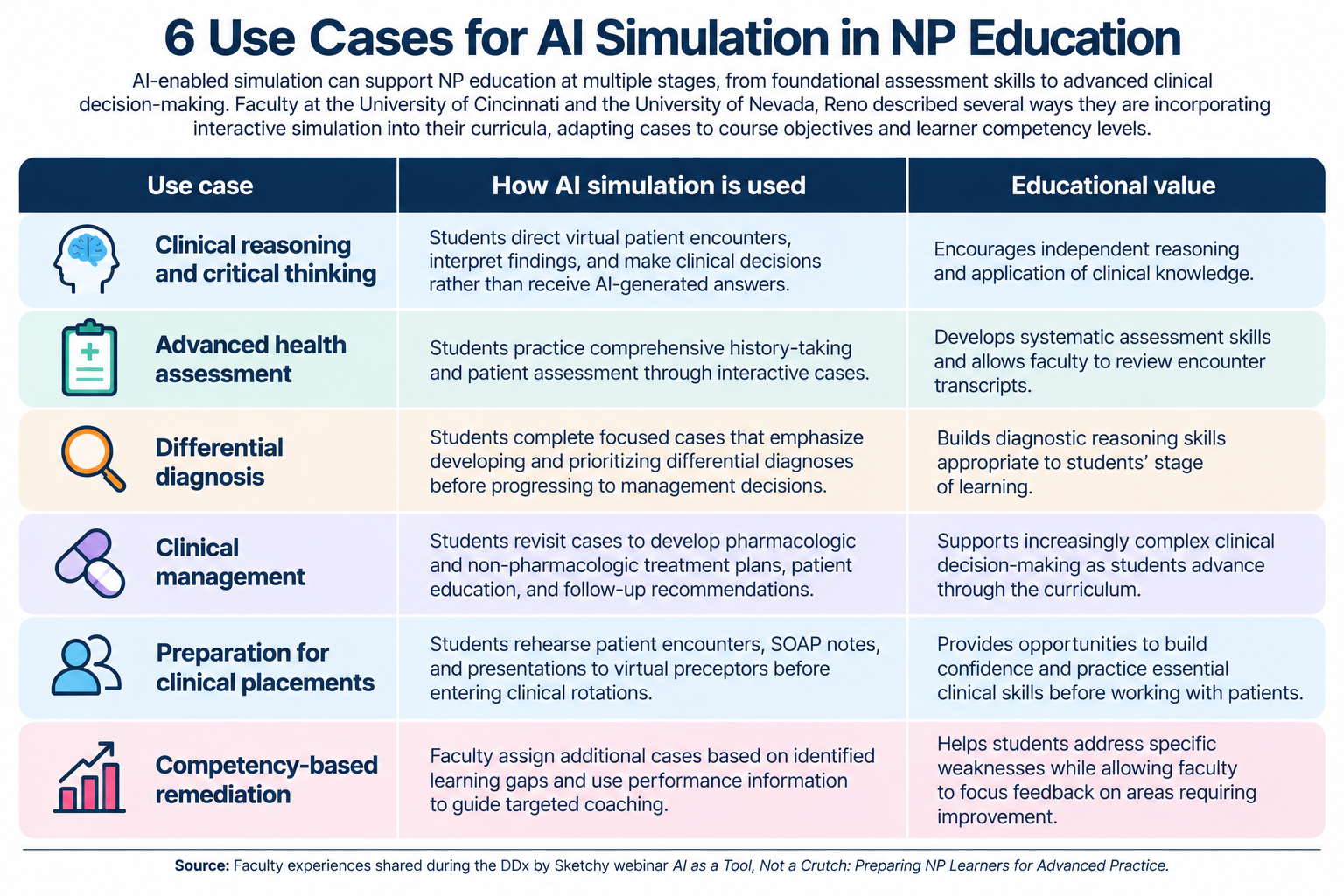
At the University of Cincinnati and the University of Nevada, Reno, faculty are using AI-enabled simulation to give students opportunities to practice clinical reasoning rather than rely on AI-generated answers. Students ask questions, interpret findings, develop differential diagnoses, and make clinical decisions.
Dr. Davis drew a distinction between AI that provides students with answers and AI that requires them to work through a problem.
"The best way to use AI intentionally is to be able to converse back and forth with AI in some way, shape, or form, so that you are actually doing the work, so that the student is pulling the answers from themselves."
For Dr. Davis, the important question is whether students are making the connections themselves: "Where does my thinking go next? To be able to connect the dots, rather than AI give them the answer directly."
DDx by Sketchy is an AI-enabled clinical readiness platform that supports this approach through interactive clinical encounters, simulated preceptors, and rubric-based assessment. Rather than receiving a static case study, students direct the encounter, deciding what to ask, which findings matter, and how to prioritize potential diagnoses.
At UNR, students responded favorably to the change. When the program initially used DDx alongside traditional discussion-board cases, Dr. Pratt recalled students saying, "No more discussion boards." UNR has since discontinued traditional discussion-board case studies in favor of DDx.
Dr. Davis also emphasized the importance of transferring what students practice in simulation to actual patient care.
"Being able to translate and apply what you learn working with AI to an actual patient encounter, that is how we quit over-relying on AI."
Why should NP programs integrate clinical simulation across the curriculum?
Both universities are incorporating AI-enabled simulation into multiple stages of NP education, adapting cases to students' developing knowledge and clinical responsibilities.
At UC, Dr. Davis said the goal was to "find something where we could start, and then scaffold that throughout the curriculum."
UC's largely online APRN courses typically enroll approximately 75 to 120 students. In advanced health assessment, faculty use DDx encounters to help students practice comprehensive history-taking. Encounter transcripts allow faculty to review whether students are "hitting the key points that we would expect from them at that stage in the curriculum," Dr. Davis explained.
In differential diagnosis, Dr. Fathman uses truncated cases that end after students develop and prioritize their differential diagnoses, without requiring clinical management decisions.
Students encounter some of those same cases again in clinical management courses, where they build on their earlier work by considering pharmacologic and non-pharmacologic management, patient education, and follow-up.
Dr. Fathman described the value of allowing the simulation experience to progress with students as they advance through the curriculum. Reusing cases also creates opportunities for faculty teaching different courses to collaborate and better understand how their coursework fits together.
Dr. Davis highlighted another benefit of using the same platform across courses:
"Every single time that the student has to reorient to a new platform creates additional stress on the student."
At UNR, Dr. Pratt described the flexibility to adjust case complexity to a student's level of competency.
"An early learner may need more structured, straightforward cases, but our advanced learners may benefit from cases that maybe have more ambiguity, competing diagnoses, complex decision making."
This flexibility is particularly relevant at UNR, where students in the clinical portion of the program may be progressing at different competency levels.
How can simulation prepare NP students for clinical placements?
UNR uses DDx in a Clinical Front Loading course that students complete before entering clinical placements. The course gives students opportunities to rehearse common patient presentations, organize encounters, and practice communicating with preceptors.
Dr. Fathman described an important transition in NP education as moving students "from RN thinking to APRN thinking."
Students may enter NP programs with strong nursing assessment skills, but their responsibilities change as they prepare to become providers.
"You're the one who now has to make these decisions," she explained.
UNR's approach to preparing students for that transition grew out of an unexpected experience during COVID.
When clinical placements were interrupted, faculty began conducting clinical-type scenarios over Zoom. After students returned to clinical settings, Dr. Pratt recalled preceptors telling faculty, "I don't know what you did, but these students are so much stronger."
The experience prompted faculty to reconsider when students should learn practical aspects of managing a patient encounter, including organizing a visit, writing SOAP notes, and presenting a patient to a preceptor.
Rather than leaving those skills to be learned during clinical placements, UNR began teaching them beforehand through Clinical Front Loading.
Today, DDx gives students additional opportunities to practice those skills through simulated encounters.
Dr. Pratt described one example:
"The fact that they have practiced giving a 2-minute patient presentation to their virtual preceptor in their virtual simulated space is, I think, really helping take some of that workload off of our preceptors."
Both Dr. Pratt and Dr. Fathman reported encouraging feedback from preceptors about student preparedness. They also clarified that this feedback was anecdotal and qualitative, rather than based on quantitative comparisons of student performance.
Dr. Davis noted that simulation may also help students manage the anxiety of entering clinical practice.
"It's so easy for us to forget, as we enter and we have all these years of clinical practice ourselves, all of the stress and anxiety that comes for students when they're very first entering that clinical setting."
She said practicing beforehand can increase students' confidence while helping preceptors feel more confident in the students they supervise.
How Can AI Simulation Support Remediation in Competency-Based NP Education?
At UNR, faculty use DDx to provide additional practice when students are struggling to demonstrate specific competencies. Dr. Pratt said the approach has changed how she spends her time on remediation.
Previously, supporting an individual student often meant creating a custom unfolding case from scratch.
"You're having to write the history and anticipate the questions they're going to ask, and develop realistic responses."
With DDx, students can complete additional cases independently while faculty review performance information and provide targeted coaching.
Dr. Pratt emphasized that the platform has not eliminated faculty work. Instead, it has changed the nature of that work.
"They are practicing independently, and then what is happening is, it's not eliminating faculty workload, obviously, but the work is shifting from me just, like, building cases constantly and facilitating every activity to really being able to review the learner performance and provide targeted coaching."
The performance data also gives Dr. Pratt more specific information to discuss with students.
Before using DDx, she recalled telling students broadly that they needed to improve their clinical reasoning, without always being able to explain precisely where they were struggling.
Now, she said, "I can give them very specific information on where that reasoning process broke down."
For Dr. Pratt, that has been one of the most valuable changes in remediation: faculty can spend less time developing individual practice scenarios and more time helping students understand and address their specific difficulties.
Hear Dr. Pratt discuss UNR's remediation approach in the webinar recording.
Can NP faculty create custom AI simulation cases?
Yes. In addition to selecting cases from the DDx library, faculty can submit requests for custom cases that align with their course objectives and students' learning needs.
Dr. Pratt has converted many of her existing faculty-written case studies and discussion-board assignments into DDx simulations by submitting a brief request form.
She estimated that preparing a custom case request takes "less than 10 minutes of my time" and described receiving completed cases within days.
In one course, students are assigned approximately 25 DDx cases over the semester. Dr. Pratt said she developed many of those cases herself.
"It took less time than I would have spent doing one traditional discussion board assignment."
She also described the ability to develop cases for specific learning objectives as an advantage over more templated simulation platforms, where faculty may have to adapt an existing case to fit their course rather than request one that addresses their intended competencies.
How do NP students respond to AI-enabled clinical simulation?
Faculty from both universities reported positive student responses to DDx, including requests for additional simulation cases.
Dr. Fathman shared several comments from UC course evaluations that described how students experienced the assignments.
One student wrote:
"The DDx cases required me to slow down, interpret evolving data, and practice making decisions as new information became available. This made the learning experience realistic and reinforced how to defend a diagnosis using evidence rather than assumptions."
Another student, asked what they would change about the course, requested more simulation:
"One change I would like is to require more DDx casework throughout the semester. It was one of the most helpful parts of the course because it allowed me to apply the concepts in a hands-on, realistic way."
Dr. Fathman was particularly struck by students asking for more assignments.
"I've never had that feedback from assignments in the past," she said.
At UNR, Dr. Pratt similarly reported that students preferred DDx to traditional discussion-board cases. She said students appreciated being able to ask questions naturally, receive realistic responses, and get immediate feedback.
These evaluations and faculty observations provide qualitative insight into how students experience AI-enabled simulation. They do not, on their own, establish measured improvements in clinical performance.
Watch the Full Conversation
The webinar AI as a Tool, Not a Crutch: Preparing NP Learners for Advanced Practice features Drs. Davis, Fathman, and Pratt discussing their programs' experiences with AI-enabled simulation.
Watch the recording for a live walkthrough of a DDx telehealth case, additional discussion of curriculum integration and remediation, and audience questions about preceptor feedback and program funding.
Interested in exploring how DDx could fit into your NP curriculum? Schedule a conversation with DDx by Sketchy.
Frequently Asked Questions
What is AI-enabled simulation in NP education?
AI-enabled simulation allows NP students to practice clinical encounters with virtual patients and preceptors. In DDx by Sketchy, students can gather patient histories, conduct simulated assessments, develop differential diagnoses, and work through management decisions. Faculty can review encounter transcripts and rubric-based performance information.
How is AI-enabled simulation different from using ChatGPT to answer case studies?
As Dr. Davis explained during the webinar, general-purpose AI tools can produce answers to written assignments without requiring students to work through the underlying reasoning. In interactive clinical simulation, students direct the encounter by asking questions, interpreting findings, and making decisions, while the AI responds within the scenario.
How can NP programs use AI simulation to develop clinical reasoning?
At UC, faculty use DDx cases across advanced health assessment, differential diagnosis, and clinical management. Students practice progressively more complex skills as they advance, including gathering information, prioritizing diagnoses, and determining treatment plans.
How can NP faculty use AI simulation for competency-based remediation?
Faculty can assign additional cases that address a student's specific learning needs. At UNR, Dr. Pratt uses DDx performance information to identify where students' clinical reasoning breaks down and provide targeted coaching after they complete cases independently.
How can simulation prepare NP students for clinical placements?
Simulation gives students opportunities to rehearse patient encounters before entering clinical practice. UNR uses DDx in its Clinical Front Loading course to help students organize visits, practice patient presentations, and develop confidence in communicating with preceptors.
Can NP faculty create custom AI simulation cases?
Yes. DDx accepts custom case requests from faculty. Dr. Pratt reported submitting requests in less than 10 minutes and receiving completed cases in approximately two days in her experience. She described using custom cases to align simulation assignments with specific course objectives.
How can NP programs integrate AI simulation across multiple courses?
UC faculty described introducing DDx in advanced health assessment, using truncated cases in differential diagnosis, and revisiting some of those cases in clinical management courses. This allows students to return to familiar scenarios while applying more advanced clinical knowledge and decision-making skills.