No items found.
FOR MEDICAL SCHOOLS

Standardize clinical reasoning across pre-clinical and clinical education

Clinical exposure is uneven. Rotations are short. Preceptors vary. And true readiness is difficult to measure.

DDx helps medical schools deliver consistent, validated clinical reasoning training for every learner, from early didactic years through clerkships and sub-internships—without adding faculty burden.

Built by physicians and medical educators, DDx gives programs a scalable, engaging, accreditation-aligned pathway to build diagnostic reasoning and clinical readiness.

Start your free trial

Consistent case exposure across rotations

When students see different cases, they develop different skills. DDx provides the most comprehensive library of faculty-designed, end-to-end clinical encounters, ensuring students encounter the breadth, depth, and variability they may miss in clinical rotations.

  • Expand early exposure for pre-clinical students with foundational cases that reinforce their knowledge base
  • Support diverse and non-traditional learners, or strengthen accelerated programs through flexible, self-paced practice
  • Broaden exposure to rare, atypical, or specialty-specific cases beyond what rotations typically provide
  • Scaffold case complexity from pre-clinical fundamentals to internship-level reasoning

High-fidelity clinical simulation

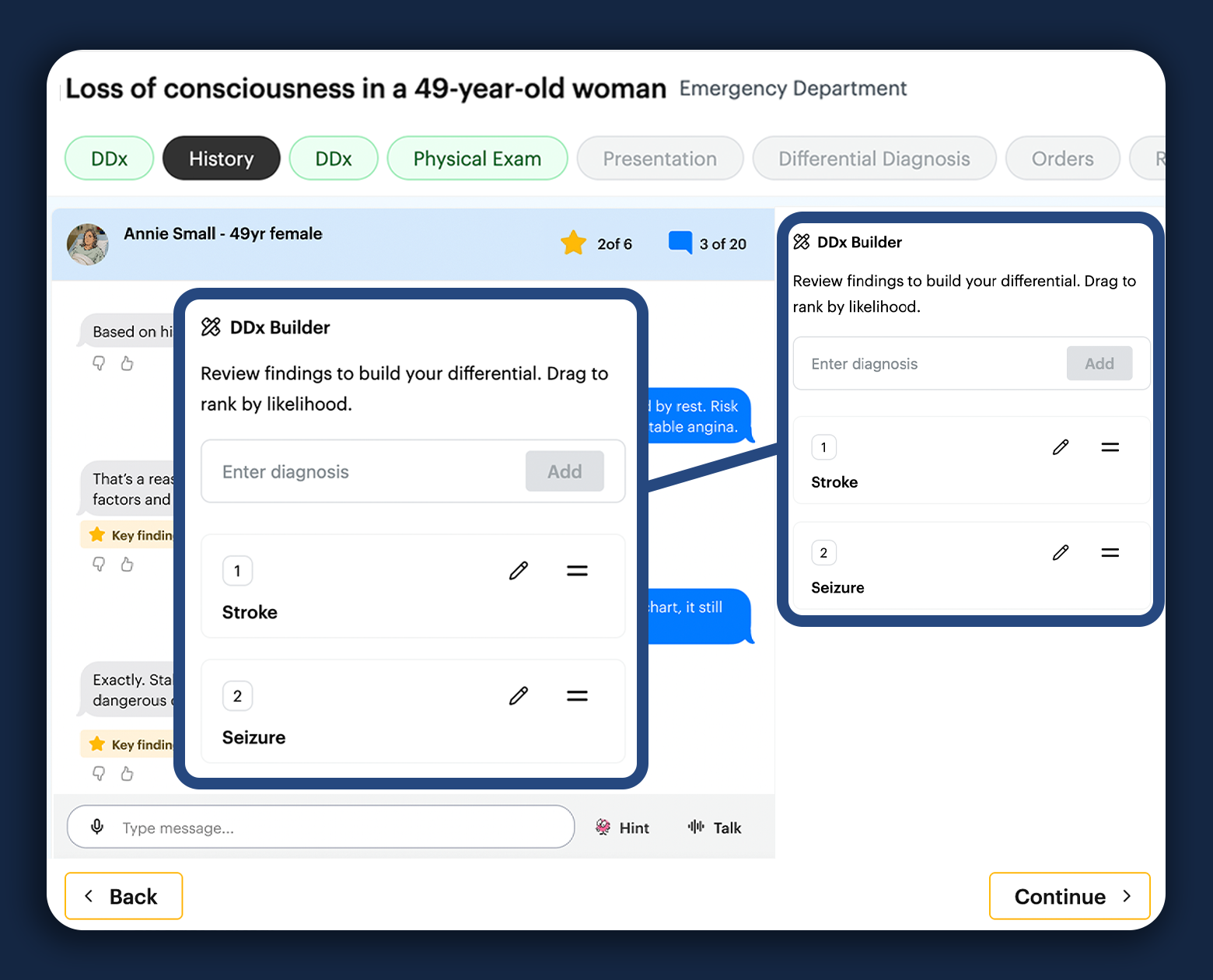
DDx recreates the full arc of an authentic clinical encounter — from history to management and disposition— mirroring what students must do on the wards and in OSCEs.

  • Supplement or replace OSCEs and SP encounters with scalable, high-fidelity DDx simulations when time, cost, or capacity is limited
  • Prepare learners for high-stakes, in-person assessments with realistic patients and preceptor interactions, differential building, and justification of diagnostic and management choices
  • Upgrade your simulation program with clinical realism at a fraction of standardized patients and simulation lab costs

Validated, competency-based assessment

DDx supports faculty with standardized, rubric-based reasoning assessment aligned to institutional competencies and accreditation standards.

  • Evaluate clinical reasoning and related competencies using our faculty-developed, rubric-based framework.
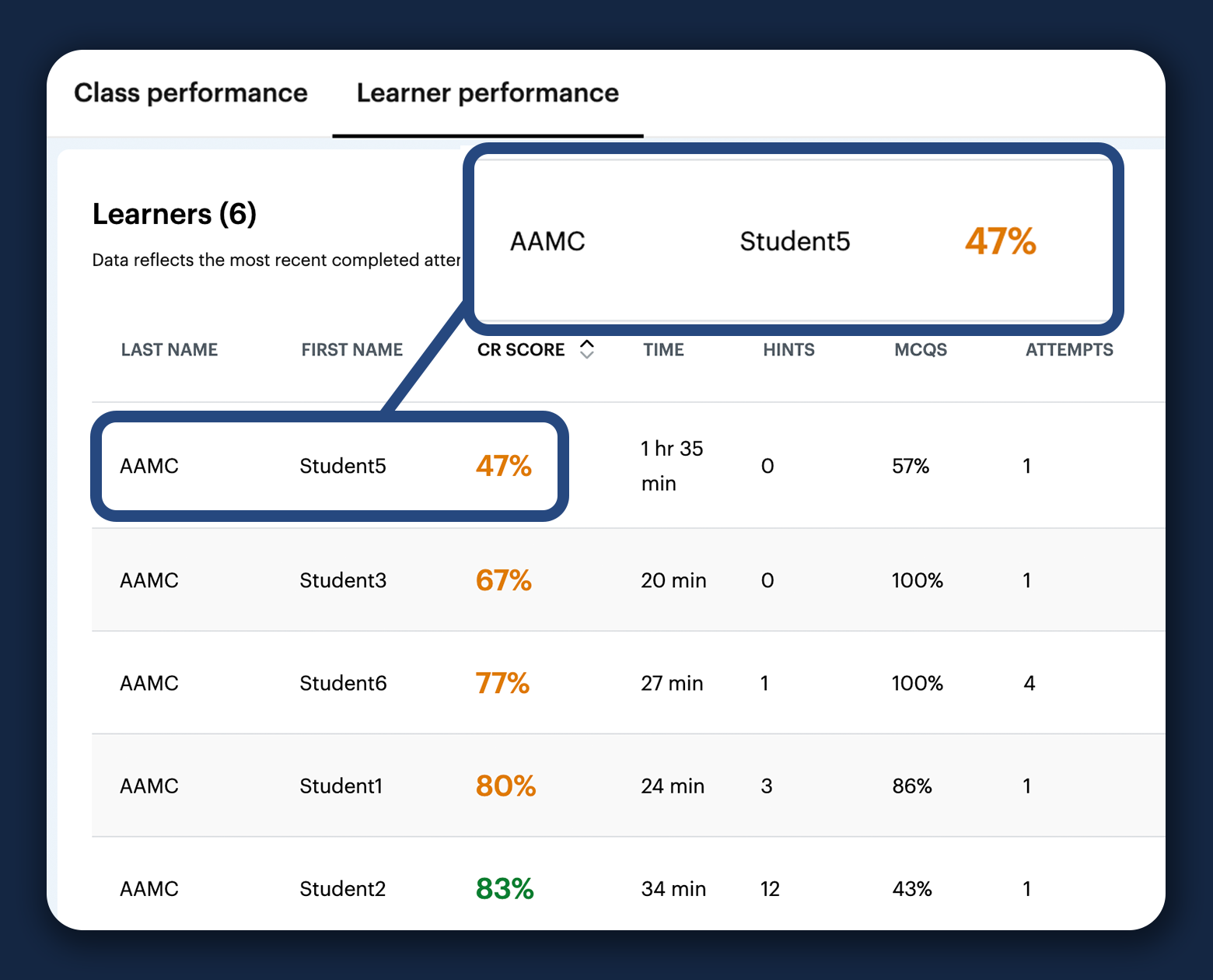
  • Track patterns and trends over time using case-based reasoning analytics at the individual and cohort-level.
  • Surface actionable data that enables earlier intervention and more effective feedback conversations.

Early identification and remediation

Clerkships move fast — and struggling students must be flagged early.

  • Detect performance gaps in test ordering, diagnostic reasoning, or management using case analytics.
  • Provide structured, competency-based feedback and targeted, case-based remediation that directly addresses specific reasoning issues.
  • Monitor improvement over time without increasing faculty workload.
Ready to experience how DDx can strengthen reasoning skills?
Start your free trial

Real impact for medical education

87%
of students report increased confidence after using DDx
80%
savings compared to SP and OSCE-equivalent simulations
Countless faculty hours saved through automated case development, delivery and assessment
100%
Unmatched insight into how students think, not just what they answer
“The platform allowed the students to engage deeply within the diagnosis process and practice reasoning in a structured and interactive format. They were really, really excited that day when we were using the tool for the first time.“
Dr. Nicole Rassi, MD, FACP
Associate Professor, University of Puerto Rico School of Medicine

The right clinical content for your curriculum

Pre-Clerkship
Clerkship
Cardiovascular
Endocrinology
GI / Hepatobiliary
Hematology & Oncology
Infectious Disease
Nervous System / Psych
Pulmonology
Renal / GU
Reproductive
Rheum / MSK / Integumentary
List of cases
Sample application

Leg pain in a 54-year-old man

Introduce the acute limb ischemia case during the cardiovascular block to reinforce vascular anatomy and the pathophysiology of arterial occlusion formation.
Sample application

Weight loss in a 19-year-old woman

Use this case in the endocrinology module to help students connect thyroid physiology to clinical patterns. They’ll learn to recognize hallmark features of hyperthyroidism, interpret thyroid labs, and differentiate Graves’ disease from other causes before entering the clinic.
Sample application

Abdominal pain in a 45-year-old man

 Use this case in PBL to give students a realistic, symptom-based presentation that pushes them to generate hypotheses, surface knowledge gaps, and connect clinical.
Sample application

Blood-streaked stools in a 55-year-old

Use this case as pre-work for a small-group session on GI pathology and social determinants of health, where students analyze how anatomic location and molecular progression influence symptoms, while also discussing how factors such as access to screening, diet, and family history contribute to risk and delayed diagnosis.
Sample application

Cough in a 2-year-old girl

Use this case before your paramyxoviruses lecture to give students a clear clinical anchor. Students come into class already distinguishing croup from epiglottitis or foreign body aspiration, making teaching time more efficient.
Sample application

Behavioral changes in a 70-year-old man

Utilize this case to reinforce pathophysiology behind common forms of dementia. Students will gain an understanding of high-yield neuroanatomical disease through hands-on, interactive means.
Sample application

Intermittent hematuria in a 64-year-old man

Assign this case to students during the renal block to help them internalize the three physiologic categories of AKI. It turns an abstract concept into a memorable clinical narrative they can carry into a small group or lecture.
Sample application

Nausea and vomitting in a 19-year-old woman

Assign this case prior to your lecture on early pregnancy. It prepares students with the foundational skills they’ll need in class—obtaining a private sexual/gynecologic history, reflexively ordering a pregnancy test, and recognizing typical early pregnancy presentations.
Sample application

Headache and blurry vision in a 74-year-old woman

Assign this high-yield case right after teaching granulomatous inflammation to help students connect multinucleated giant cells on slides to real clinical consequences.
Emergency Medicine
Internal Medicine
Family Medicine
Neurology
OBGYN
Pediatrics
Psychiatry
Surgery
List of cases
Sample application

Chest pain in a 22-year-old woman

Incorporate the pericardial tamponade simulation into a focused procedures workshop where students use bedside ultrasound to identify right-sided chamber collapse and then walk through the steps, indications, and complications of performing an emergent pericardiocentesis.
Sample application

Dysuria in a 25-year-old man

Assign this case before students begin FM rotations to prepare them for one of the most common primary-care presentations. They’ll learn to get a focused sexual history, recognize when STI is more likely than UTI, and manage testing and treatment confidently.
Sample application

Variceal upper GI hemorrhage

After a student struggles to distinguish types of GI bleeds, use this case to sharpen their instincts: spot cirrhosis clues early, prioritize variceal bleeding on the differential, and start the key first steps—IV access, fluids, PPI, octreotide, antibiotics—before GI gets there.
Sample application

Numbess and tingling in a 29-year-old woman

Use the multiple sclerosis simulation during the neurology clerkship to have students localize lesions based on presenting deficits, interpret lumbar puncture and MRI findings, and coordinate care with neurology, physical therapy, and ophthalmology as they build a management plan for an acute flare.
Sample application

Decreased fetal movement in a 17-year-old girl

After a busy L&D shift where a student documents “elevated BP at term” but can’t clearly distinguish gestational hypertension from preeclampsia with severe features, assign this case to solidify diagnostic criteria, lab interpretation, and when delivery is the right next step.
Sample application

Progressive vomitting in a 5-week-old infant

Assign this case during a student’s pediatrics clerkship to reinforce multidisciplinary management pathways, including recognizing dehydration and metabolic alkalosis in the ED, coordinating stabilization, and collaborating with surgery to plan the timing and preparation for pyloromyotomy.
Sample application

Depressed mood in a 42-year-old woman

After a clinic encounter where a student labels low mood as “MDD” without assessing chronicity, use this case to train them to recognize chronic, low-grade depression (persistent depressive disorder) and to base their diagnosis on course, chronicity, and function—not just the symptom list.
Sample application

Abdominal pain in an 18-year-old man

Assign the appendicitis case as pre-work before a student scrubs into an appendectomy to help familiarize students with forming a differential for acute abdominal pain, interpreting ultrasound or CT findings, and coordinating timely consultation with surgery and anesthesia to prepare the patient for appendectomy.


How MD and DO programs are using DDx

DDx is designed for the realities of modern medical education — variable student preparation, limited faculty time, and inconsistent clinical exposure across clerkships.

  • Aligning DDx cases to build upon OSCEs, simulation curricula, and clerkship expectations, reinforcing the same reasoning framework across environments
  • Enhancing transition to residency curriculum and residency preparation through advanced clinical simulations and clinical skills modules
  • Tracking clinical reasoning development longitudinally, giving faculty objective insight into student progress, knowledge integration, and readiness for clerkships and residency
  • Providing a structured framework with automated, individualized, and actionable feedback to support struggling learners or learners on non-traditional curricular cycles

Prepare every student for clinical practice

DDx equips medical schools with scalable, realistic, clinical reasoning education — built by physicians, trusted by institutions, and aligned with medical training needs. Contact us to learn more.

Frequently asked questions

What is DDx? And why did you build it?

Built by medical professionals, DDx is the trusted, AI-powered clinical readiness platform that empowers educators to deliver standardized, interactive, and future-ready clinical reasoning training across every phase of clinical education. Learn more about our approach here: https://educators.sketchy.com/our-approach

How is this product AI-enabled? And how do you account for AI-accuracy?

DDx utilizes advanced artificial intelligence architecture to create dynamic real-world simulations. The AI guides students through multi-role interactions, diagnostic processes, and treatment planning, offering real-time feedback to help develop clinical reasoning skills in a risk-free environment. AI responses in DDx are based on expert-vetted information to ensure realistic and clinically accurate communication. Each case goes through multiple rounds of quality assurance (QA) conducted by faculty subject matter experts (SMEs) and the DDx content team (clinical professionals), as well as ongoing student testing. AI responses are also updated on an ongoing basis based on validated research and faculty feedback to ensure continued accuracy and reliability.

How are DDx cases different from ChatGPT?

DDx by Sketchy is a faculty-led clinical reasoning platform built for clinical education with structured, interactive patient cases that simulate real-world clinical encounters. Students and residents practice history taking, differential diagnosis, decision-making, and management while receiving rubric-based feedback and learner analytics designed to strengthen diagnostic skills in context—not just generate text. Each case is authored and reviewed by clinicians and tied to competency-aligned assessment.

What is the process for creating cases?

Every DDx case is written and reviewed by our expert clinical educator (all MDs/PAs/NPs) team to ensure it meets the needs of learners and the highest educational standards. AI supports the experience by enhancing interactivity, engagement, and personalization, and by surfacing insights for faculty—while never replacing human clinical judgment.

Is piloting with students an option?

Yes! To schedule a demo or start a pilot, email us at Sales@sketchy.com

How customizable is DDx?

DDx uses expertly pre-created cases designed to ensure consistency, quality, and clinical rigor. While individual cases aren’t editable, faculty can customize how DDx is used within their curriculum by selecting specialty-relevant cases, assigning them across courses or rotations, setting pacing and timelines, and using learner insights to target specific skills and outcomes. Case creation tool allows instructors to easily differentiate cases by creating their own. In just minutes!

How much faculty time is required to implement DDx?

3-6 hours! DDx is easy to implement and designed to fit seamlessly into existing courses or rotation. Our sales and customer success teams partner closely with faculty to handle setup, onboarding, and best-practice guidance! That way most educators can get up and running quickly with minimal time and effort. Check out this implementation blog for more information: https://educators.sketchy.com/posts/getting-started-with-ddx

What kind of analytics or reporting does DDx provide for faculty?

DDx provides detailed class-level and learner-level performance insights that highlight knowledge gaps, areas of strength, and patterns in clinical reasoning. Faculty can see not only what learners did well or struggled with, but also the rationale behind decisions.

Does DDx integrate with our LMS? (Canvas, Moodle, Blackboard)

DDx does not currently offer direct LMS integration. However, the platform supports multiple options for sharing and uploading learner work into an LMS. Programs commonly have students upload summaries or completion evidence, and we continue to enhance reporting formats to make this process easier and more seamless for faculty and learners.

How safe is DDx? (security on the software, information sharing externally)

DDx is built with privacy and data security at its core. Sketchy follows strict data protection standards to safeguard learner and institutional information.The full Sketchy Privacy Policy is available at www.sketchy.com/privacy.

What are DDx’s SSO capabilities?

DDx requires basic user information to provision licenses and offer program access. This information is collected either as a one-time file for rostering or through an integration to enable SSO.

How can DDx be incorporated into my UME curriculum?

DDx reinforces clinical reasoning across OSCEs, simulation, clerkships, and end-of-medical-school residency preparation using a consistent, case-based framework. It supports advanced clinical skills training, tracks learner development longitudinally, and delivers structured, individualized feedback—helping faculty assess readiness, support struggling learners, and scale clinical education without added burden. DDx also enables standardization of case-based learning across distributed campuses and clinical sites, ensuring all students engage with the same high-quality reasoning experiences. By emphasizing higher-order clinical thinking—such as diagnostic synthesis and management decision-making—DDx complements foundational knowledge instruction and supports preparation for clinical assessments throughout medical school. For more information on relevant use cases, check out recent case studies or contact our team at Sales@sketchy.com.

Can I use DDx for both summative and formative assessments?

Yes. DDx supports formative use as well as summative assessment. Faculty can use Test mode to align with assessment goals.

Is DDx aligned with competencies or accreditation standards?

Yes. Developed in collaboration with expert clinician-educators, the DDx Clinical Reasoning Assessment builds on validated frameworks such as ART (Assessment of Reasoning Tool) and IDEA (Identifying, Developing, and Evaluating Arguments), adapted for DDx’s interactive virtual patient environment. The assessment uses clearly defined performance anchors across key dimensions of diagnostic and management reasoning, with rubric criteria mapped to nationally recognized Undergraduate Medical Education (UME) competencies, including those from the AAMC, AACOM, and ACGME, supporting alignment with accreditation and programmatic assessment standards.

How can DDx be incorporated into my NP curriculum?

DDx integrates seamlessly across didactic courses, simulation, and clinical rotations to reinforce clinical reasoning in specialty-specific contexts. Interactive cases mirror real primary and acute care encounters, helping NP students practice diagnosis and decision-making while receiving structured feedback and progress tracking to support clinical readiness. For more use cases check out the resources available here! Course Integration (Didactic) Assign DDx cases as required weekly activities aligned to body systems or course topics Replace or supplement traditional written case studies with interactive, case-based simulations Embed cases into clinical reasoning, differential diagnosis, and clinical management courses Pair DDx cases with readings, lectures, or exams to reinforce applied learning Simulation & Skills Preparation Use DDx as pre-work for simulation days or OSCEs Assign communication and voice-based cases prior to standardized patient encounters Support skills check-offs for counseling, shared decision-making, and difficult conversations Reinforce I-PASS handoffs, informed consent, and patient education competencies Clinical Readiness & Reasoning Development Assign longitudinal cases across semesters to track clinical reasoning growth Use DDx as “clinical warm-ups” before lab, simulation, or practicum sessions Standardize learning experiences across variable clinical placements Identify learner gaps early through performance analytics and feedback Integrate high-stakes communication practice into: health counseling courses, ethics or professional practice courses, simulation and skills labs, practicum preparation modules

Is DDx aligned with NP competencies or accreditation standards?

Yes. The Clinical Reasoning Assessment includes clearly defined performance anchors across key dimensions of diagnostic and management reasoning based on published frameworks like ART and IDEA. Rubric dimensions are mapped to the INACSL and NONPF standards.

How can DDx be incorporated into my PA curriculum?

DDx supports PA programs by reinforcing clinical reasoning across didactic coursework, OSCEs, simulation, and clinical rotations using a case-based framework aligned with PA competencies and practice expectations. It helps students prepare for the transition to clinical year and practice through advanced clinical scenarios, tracks clinical reasoning development longitudinally, and delivers structured, individualized feedback—giving faculty clear insight into readiness while supporting struggling learners and scaling instruction without added faculty burden. For more PA-specific use cases, explore the resources available here: https://educators.sketchy.com/case-studies

Is DDx aligned with PA competencies or accreditation standards?

Yes. The Clinical Reasoning Assessment includes clearly defined performance anchors across key dimensions of diagnostic and management reasoning based on published frameworks like ARC-PA 6th edition and B2 Standards.

Can I use DDx for both summative and formative assessments?

Yes. DDx supports formative use as well as summative assessment. Faculty can use Test mode to align with assessment goals.